Sustaining a Child Protection Culture Year-Round
SEO Term: child safety culture youth organizations
What Happens After Child Abuse Prevention Month Ends: Sustaining a Child Safety Culture Year-Round
I have defended many youth organizations in litigation involving harm to children. Let me tell you what the worst moment in a deposition sounds like. The attorney asks: “When did you last read your child safety policy?” Your client pauses. Looks at the ceiling. Says, “I don’t know.”
That answer is hard to overcome. Not immediately — sometimes it takes years — but it puts a ceiling on what you can argue and a floor on what you will pay. And it happens routinely, because organizations pour energy into creating child safety policies and then let those policies collect dust until something forces someone to open the binder again.
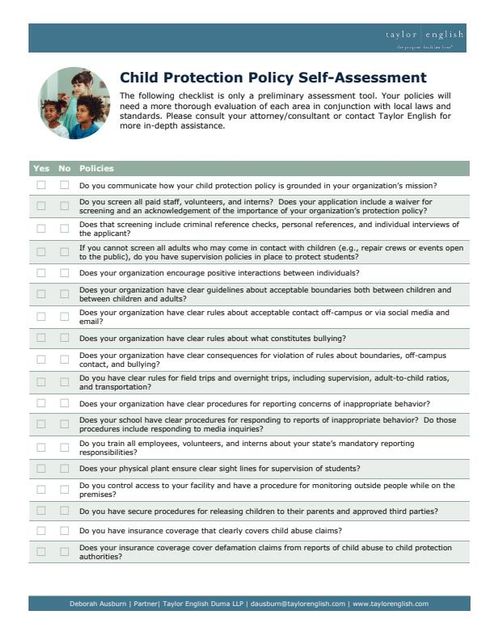
As Child Abuse Prevention Month comes to a close, take a look at what happens next. If your organization has built your child protection policy, you have done the easier part. A policy you do not maintain, revisit, and enforce consistently protects no one — and creates exactly the kind of documentary record that opposing counsel will use against you when that deposition comes.
The Annual Policy Review: What It Actually Requires
Every year, get your response and safety teams back in the room. Pull out the policy. Pull out the incident reports from the past twelve months. Ask the fundamental question: are these policies working?
I am specific about “in the room” because the annual review I am describing is not a single administrator rereading the document and noting that nothing has changed. You need leadership, frontline staff, legal counsel, and at least one board-level representative present. Walk through the policy section by section and measure it against what actually happened in your program.
Two categories of change require immediate attention. First, operational changes within your organization. Has your programming expanded? A summer camp that added an overnight component, a mentoring program that extended to off-site meetings, or a youth group that launched a social media presence each introduces risks the original policy likely did not address. If the policy was not updated when those program elements were added, it needs to be updated now.
Second, legal changes. The Child Welfare Information Gateway maintains a comprehensive database of state mandatory reporting statutes. Consult it during every annual review. I have seen organizations operating under outdated reporting obligations for years because no one checked whether the law had changed. When the organization’s policy does not match the current statute, the policy is a liability, not a protection.
The annual review also includes a staff file audit. Check whether reference checks produced documented responses — not just that someone called, but a written record of what the reference actually said. Verify that background check results include a written determination showing that a qualified person reviewed the result and made a decision about fitness for the role. These details matter enormously in litigation because they are the difference between “our process was followed” and “our process exists on paper.”
Run the Psychological Safety Surveys Again
If you conducted a psychological safety inventory during your initial policy development, resurvey at least annually. There are two things a resurvey tells you that a policy review cannot.
First, whether your reporting culture still functions. Do staff feel safe raising concerns about a colleague’s conduct? Do they trust that leadership will respond without retaliation? Can they raise questions about how a policy operates without getting uninvited to lunch? Psychological safety degrades over time without active maintenance. A resurvey catches that erosion before it silences the next person who sees something wrong.
Second, whether your policies actually function for the people who implement them every day. Staff develop compliance fatigue. They have enforced the physical contact policy for a full year, maintained the two-adult rule through every late pickup and last-child-remaining scenario, navigated every moment when it would have felt easier to simply handle it alone. They need a structured channel to tell leadership how those policies operate in practice — what creates unnecessary friction, what gaps exist that no policy drafting committee could have anticipated, and what requirements are being quietly ignored because they are impossible to meet.
Survey three audiences: staff, participants where age-appropriate, and parents. Avoid direct questions that shut down conversation. Instead of “Have you seen anyone violate our policies?” ask: “Have you witnessed any incidents that concerned you?” “Have you ever seen something you wanted to report but felt unsure how to do so?” “Are there aspects of our safety practices that you think need improvement?” Offer anonymous response options. Young people will tell you they have too much homework. But buried in those responses, you will find the observations that matter — the concerns no one raised in a meeting, the patterns no supervisor noticed, the gaps that your incident reports will never capture.
Diagnose Shortfalls Before Responding to Them
Your audit and surveys will reveal gaps. Every organization has them. The diagnostic question that determines whether you respond effectively is not “what went wrong” but “what kind of problem is this?”
I walk organizations through four diagnostic categories. A monitoring problem means the policy exists and staff know about it, but nobody checks whether people follow it. A training problem means staff do not understand the policy well enough to implement it consistently. A resources problem means the organization genuinely cannot fund the required screening, staffing ratios, or supervisory coverage the policy demands. An aspirations problem means the organization set a standard it cannot meet and has been quietly living with the gap.
Each diagnosis produces a different response. A monitoring problem requires better oversight structures. A training problem requires better training. A resources problem requires either new investment or an honest board-level conversation about what the budget actually supports. An aspirations problem requires the courage to adopt a more realistic standard and enforce it consistently.
Let me say this plainly because it matters for both child protection and litigation defense: a policy you enforce consistently at a realistic standard protects children. A policy you enforce sporadically at an aspirational standard protects no one. It also produces exactly the testimony that opposing counsel prefers in a deposition: “So you wrote a policy requiring X, and you didn’t follow it?” Three reference checks enforced every time is better child protection than five reference checks enforced half the time.
Annual Training and the Child Safety Summit
Annual refresher training for all staff is not optional. It should cover mandated reporter refresher content, a review of any policy changes from the annual audit, and scenario-based exercises that require staff to apply the policies under realistic pressure — not just acknowledge that the policies exist.
Industries where the stakes of failure involve physical harm — engineering, mining, construction — host regular safety summits. They bring in outside speakers. They audit processes. They review incidents and near-misses. They treat safety as a permanent operational function, not an annual obligation to discharge.
Your organization can build the same structure. An annual child safety summit brings your entire staff together and treats the topic with the seriousness it deserves. Invite a child protection attorney, a law enforcement specialist, or a clinician who works with child abuse survivors to speak. Review the year’s incidents. Identify what worked. Name what did not. If budget does not allow an external event, a dedicated staff development day carries the same value if leadership treats it as a genuine priority and not a compliance checkbox.
Board-Level Accountability Is Not Delegable
Child safety ultimately rests at the governance level. Boards that treat it as an operational detail — delegated to staff and reviewed when something goes wrong — fail to exercise the oversight their fiduciary and legal responsibilities require.
Every YSO board should maintain a standing child safety agenda item at every meeting. Not an annual presentation. Not a quarterly update. A permanent line item that tracks policy compliance, incident reports, and emerging concerns. The board should review and formally approve any substantive policy changes at the annual review. Leadership should provide immediate notification when an allegation arises — before the board reads about it elsewhere.
Build the Twelve-Month Cycle
Organizations that actually protect children year-round treat child safety as a cyclical operational function — on the same calendar as financial management and strategic planning. Consider which parts of the following safety calendar would work for your organization:
– First quarter (January–March): Conduct the annual policy review. Reassemble safety teams. Run the psychological safety resurvey. Audit staff files. Update policies to reflect new programming, legal changes, and lessons from the prior year.
– Spring: Deliver annual refresher training. Host the safety summit. Brief seasonal and summer staff before programming begins. Audit facilities and digital systems.
– Summer: Implement enhanced supervision for expanded programming. Conduct mid-season check-ins with frontline staff about concerns and near-misses. Do not wait for fall to learn what summer produced.
– Fall: Review incidents from the high-activity summer period. Conduct scenario-based training on lessons learned. Identify policy gaps before they carry into the next program year.
– Year-end: Present the annual child safety report to the board. Collect updated staff climate data. Set explicit priorities for the year ahead and document them where someone will be held accountable for following through.
The Standard That Matters
Your policy binder may contain an excellent document. What is in writing matters far less than what is enforced. The children in your program do not experience the binder. They experience the culture — the daily practices, the staff behaviors, the organizational responses when something goes wrong — and that culture either protects them or it does not.
Review your policies at least annually. Audit your records. Run your surveys. Diagnose shortfalls honestly and respond to the actual cause. Train your staff. Hold your board accountable for oversight. And the next time an attorney asks when you last read your child safety policy, make sure the answer is immediate, specific, and true.
There is no “one and done” in child protection.
Sources
Centers for Disease Control and Prevention. “Programs: Child Abuse and Neglect Prevention.” https://www.cdc.gov/child-abuse-neglect/programs/index.html
Child Welfare Information Gateway. “Mandatory Reporters of Child Abuse and Neglect.” U.S. Department of Health and Human Services, Children’s Bureau. https://www.childwelfare.gov/topics/systemwide/laws-policies/statutes/manda/
National Children’s Alliance. “NCA’s National Standards of Accreditation for Children’s Advocacy Centers.” 2025 Revised Edition. https://www.nationalchildrensalliance.org/ncas-standards-for-accredited-members/