Five Policy Gaps That Leave Children Vulnerable—And How to Close Them Before Summer Programming Starts
Child Abuse Prevention Month — April 2026
Summer programming season approaches fast, and with it comes an influx of new staff, expanded activities, and extended hours of direct contact between adults and children. For youth-serving organizations, summer represents both an extraordinary opportunity to serve young people and a period of heightened vulnerability. The casual atmosphere, the temporary staff, the off-site activities—each introduces risk that year-round policies may not adequately address.
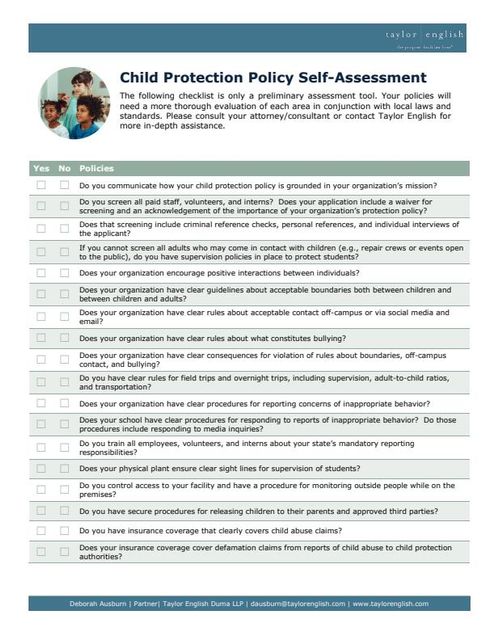
Child Abuse Prevention Month falls at exactly the right moment in the calendar to force a critical question: Does your organization’s child safety policy actually cover the situations your staff will face this summer? In our experience working with youth-serving organizations across the country, five gaps appear with remarkable consistency—and each one creates a window of vulnerability that a motivated offender can exploit.
GAP 1: ONE-ON-ONE CONTACT POLICIES THAT EXIST ON PAPER BUT NOT IN PRACTICE
Most youth-serving organizations maintain some version of a policy restricting one-on-one adult-child contact. Few enforce it consistently, and fewer still design their physical spaces and program schedules to make compliance practical.
A policy that says “Staff should avoid being alone with a child” fails on multiple levels. It uses aspirational language (“should avoid”) rather than directive language (“must not”). It fails to define what “alone” means—does a closed-door office count if the door has a window? Does a vehicle during transportation count? Does a hallway conversation after other children have left count? And it offers no guidance about the many situations in which one-on-one contact may be necessary—counseling a distressed child, administering first aid, or addressing a behavioral crisis.
Closing this gap requires specificity. Effective one-on-one policies define the concept clearly, identify the contexts in which it arises, establish the conditions under which limited one-on-one contact may occur (observable and interruptible spaces, notification of a supervisor, documentation), and create practical alternatives for situations that require privacy but need safety. Organizations should walk through a typical program day and identify every moment when an adult might end up alone with a child, then design protocols for each one.
GAP 2: NO POLICY ON DIGITAL COMMUNICATION BETWEEN STAFF AND MINORS
Here stands a reality that many legacy child safety policies simply do not address: the most common channel of inappropriate contact between adults and minors in organizational settings now runs through personal devices. Text messages, direct messages on social media, private chats within gaming platforms, and communication through apps that offer disappearing messages all create unmonitored, private channels that replicate the isolation of a closed room.
Organizations that restrict one-on-one physical contact but allow unrestricted digital communication between staff and minors have built a wall with a wide-open door. A comprehensive digital communication policy addresses several critical questions: Which platforms and methods may staff use to communicate with minors? Must all communication occur on organizational accounts or platforms? Must a parent, supervisor, or second adult receive copies of all messages? What content boundaries apply—and what happens when someone violates them?
Technology often provides predators with a private channel to build relationships with children outside organizational oversight. Your digital communication policy should eliminate that channel—or at minimum make it observable.
Summer programming intensifies this risk because temporary staff, seasonal volunteers, and camp counselors often develop close relationships with young people over compressed timeframes. Without clear digital boundaries, those relationships migrate to personal channels the moment the program time ends.
GAP 3: TRANSPORTATION PROTOCOLS THAT DON’T ADDRESS REAL SCENARIOS
Transportation creates some of the highest-risk moments in youth programming. A vehicle provides a private, enclosed space with no external observation. Field trips, athletic events, drop-offs after late programming, and emergency transportation all create situations in which a child may ride alone with an adult—often with parental knowledge but without organizational oversight.
Many organizations address transportation with a single sentence: “Adults should not be along with a child during transportation.” But that sentence fails to account for the situations that actually arise: the last child waiting for a late parent, the emergency medical transport, the staff member who offers to drive a child home because the bus already left. Each of these scenarios creates real one-on-one contact that a simple two-person rule does not resolve.
A robust transportation policy addresses protocols for last-child and late-pickup situations, explicit prohibition on the use of personal vehicles without prior organizational approval and parent consent, communication requirements during transport (GPS tracking, check-in calls), and documentation procedures for any transport outside the standard schedule.
Close this gap before summer by mapping every transportation scenario your program generates—regular and irregular—and building specific protocols for each one.
GAP 4: NO FRAMEWORK FOR OVERNIGHT OR EXTENDED-HOUR PROGRAMMING
Summer brings overnight camps, retreats, lock-ins, and late-evening programming. These extended-contact settings amplify risk in several ways: children feel tired and emotionally vulnerable, supervision staffing often thins during nighttime hours, sleeping arrangements create proximity and privacy, and the relaxed atmosphere of overnight programming erodes the professional boundaries that daytime settings reinforce.
Organizations that run overnight programming need policies that address shower and changing protocols (scheduled times, supervision structures that protect privacy while maintaining safety), nighttime supervision ratios and check-in procedures, and clear boundaries around physical comfort—particularly with younger children who may seek physical proximity when away from home.
The American Camp Association (ACA) provides detailed accreditation standards for supervision structures in overnight programming, including age-specific staff-to-camper ratios and requirements that staff training address minimizing one-on-one interactions. Organizations of all types can adapt this guidance. If your organization runs any form of overnight or extended-hour programming, your policy should address the specific risks those settings create. A daytime-focused policy applied to an overnight setting leaves dangerous gaps.
GAP 5: AN INCIDENT RESPONSE PLAN THAT STOPS AT “REPORT IT”
Perhaps the most consequential gap in youth-serving organizations’ child safety infrastructure concerns what happens after someone reports a concern. Many organizations have invested in training staff to recognize warning signs and file reports. Far fewer have built the infrastructure to process, investigate, and respond to those reports effectively.
An incident response plan should answer specific questions at every stage: Who receives the initial report? What information must the reporter provide? Who determines whether to contact law enforcement or child protective services—and what training qualifies that person to make that determination? What happens to the accused person’s access to children while the organization assesses the report? Who communicates with the reporting family, and when? How does the organization document its decision-making at each stage?
Without answers to these questions, organizations default to improvisation during a crisis. Leaders make decisions under pressure without a framework, communication breaks down, and the organization’s response compounds the harm rather than containing it.
CLOSING THE GAPS BEFORE SUMMER
The five gaps described above share a common feature: they reflect the difference between having a policy and having a functional system. A policy binder that sits on a shelf protects the organization’s lawyers, not its children. A functional system lives in the daily practices of the people who implement it.
Use the weeks between now and the start of summer programming to audit your organization against each of these gaps. Convene your leadership team, walk through your program’s actual operations, and ask where a child could end up vulnerable despite your existing policies. Then build the specific protocols, training sessions, and accountability measures you need to close each gap before the first child arrives.
Prevention happens in the details. And the details matter most in the months when your programs serve the most children, employ the most staff, and operate in the most diverse settings. Summer approaches. Make sure your policies stand ready for it.