Lessons from Drowning Death
The reports about a district attorney’s recent press conference in Massachusetts contain some important lessons for youth-serving organizations. The DA in Pittsfield, MA has charged two middle school educators with involuntary manslaughter and related crimes after the 2024 drowning death of a young teen during a school field trip. We are seeing more frequent criminal charges after tragedies involving children, inevitably followed by civil claims against the organizations involved. I haven’t yet seen any reports of a civil lawsuit against the school involved, but I expect lawyers for the teen’s parents will be filing one without much delay.
As with all one-sided legal filings, the indictments that the DA announced tell only his side of the story. The facts that he set out, however, paint a picture of untrained and overwhelmed staff. Several important lessons stood out to me from the reports of the press conference:
1. The young teen allegedly did not know how to swim, but the teachers didn’t enforce a requirement that each child undergo a swim test before allowing them into the lake. The DA also said that the teachers didn’t ensure that the area had flotation devices. Camps and organizations that have swimming facilities need to follow basic rules of safety for swimming programs. These rules are part of your standard of care, and locating them needs to be your first research project for your program.
2. Statutes and regulations always provide non-negotiable standards, and Massachusetts apparently has a law that applies here. It requires that minors in certain swimming programs be swim-tested and provided with a personal flotation device if they are a non-swimmer or weak swimmer. The DA based at least part of his criminal charges on the violation of this law, and I expect any subsequent civil suits will cite it as well. Youth organizations need to be certain that they know all the statutes and regulations that apply to their program and that policies are in line with those requirements.
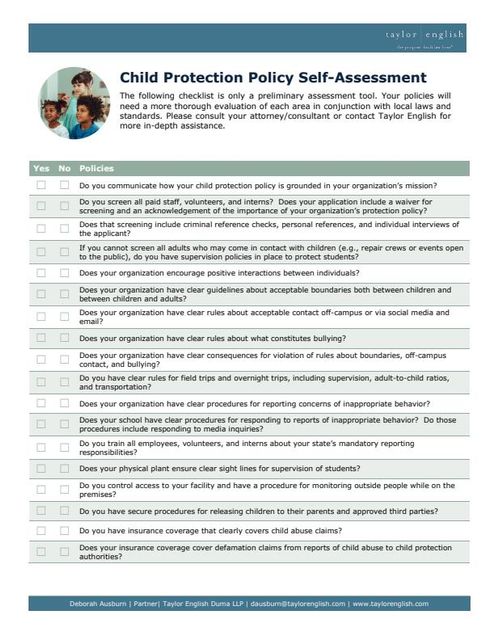
3. According to the DA, one of the educators charged said that she had not heard of the law, and neither staff member was given any orientation about swimming activities on the trip. This claim, if true, indicates a serious lack of training. If your staff doesn’t know your standards, they can’t apply them. As my co-author and I say often in our teaching sessions and our book, it doesn’t matter how good your written policy is if your staff doesn’t follow it. Adequate training is an essential part of a strong child protection policy. Furthermore, it needs to be in writing. If your staff later can’t remember any training, you need to be able to show documentation that you actually provided that information.
4. The DA said that the investigation showed that the trip was running behind schedule, so the chaperones changed the plan from two smaller groups of students to allowing all of the children in the water at the same time. The article refers to a permit for the trip indicating 25 children when actually there were 35, more than one lifeguard could safely monitor. The clear impression is that the staff members in charge were trying to deal with schedule changes and disruptions. Hurried decisions rarely are safe decisions, especially when staff members are inexperienced and/or untrained.
5. The article also mentions that there was no roll call or buddy system in place. It’s not clear whether the state park that hosted the group or the school employees had primary responsibility for enforcing those safety rules, but knowing where children are at all times is a basic safety standard for any youth program. Whether your kids are swimming, on a ropes course, or just hanging out, you need protocols to be able to know where each participant is and what they are doing at any point in time.
6. The DA said that the permission form for the field trip didn’t mention swimming. If your program gets permission from parents, you need to outline all of the activities, particularly those that carry some level of risk. Parents of kids in your organization need to know exactly what risks they are allowing their children to undertake and to be able to ask informed questions about your safety plan. Parents are important partners for your program, and as partners need all of the relevant information about your program.
7. Finally, the article mentions claims that at least three children reported to one of the staff that the teen was struggling and had gone underwater, but the staff member did nothing. Again, we are only hearing one side of the story, but it is very easy for our employees and volunteers to find themselves dealing with a lot of information coming at them at once. Sometimes it’s only in hindsight that we see the importance of a particular report. We need to develop procedures and policies in our organization to help staff quickly and accurately sift through all of the information that they are getting. Sometimes we need to add more staff or other resources, and sometimes we may need to reassign responsibilities. Overwhelmed staff can be a weak spot for many organizations.
This tragedy is a nightmare scenario for anyone who cares for children. We can’t prevent all danger to our children, but we can make our activities as safe as possible. We need to know the standard of care for organizations like ours, ensure that we have trained our staff, provide our staff the information and resources they need to deal with inevitable setbacks, and include parents in planning and policies. Having strong child safety policies requires us to have safety woven throughout our organization’s culture so that a series of weaknesses and accidents doesn’t lead to tragedy.
*